
-

Amyloid Beta ( 35-40 ) ( 1A10 ) Aβ Anti-Human Mouse IgG MoAb 1
Alzheimer's disease (AD) is characterized by the presence of extracellular plaques and intracellular neurofibrillary tangles (NFTs) in the brain. The major protein component of these plaques is beta...
Add to Cart$143.00 -

CD109 (11H3) Anti-Human Mouse IgG MoAb 1
CD109 is a glycosyl-phosphatidyl-inositol (GPI) - anchored glycoprotein about 180 - 190 kDa. It is shown that CD109 is expressed in vascular endothelial cells, some epithelial cells, activated...
Add to Cart$143.00 -

c-MPL/TPOR (AMM2) Anti-Mouse Rat IgG MoAb 1
Thrombopoietin promotes the growth and differentiation (proliferation) of megakaryocytes which produce platelets. TPOR (Thrombopoietin receptor), which is also called c-MPL (Myeloproliferative...
Add to Cart$143.00 -

Amyloid Beta E22P ( 11A1 ) Aβ Anti-Human Mouse IgG MoAb 1
Alzheimer’s disease (AD) is characterized by the presence of extracellular plaques and intracellular neurofibrillary tangles (NFTs) in the brain. Aggregation of the 42-mer amyloid β-protein (Aβ42)...
Add to Cart$143.00 -

Angiotensinogen (104AT 601.2.80) Anti-Human Mouse IgG MoAb 1
Angiotensinogen is the precursor of angiotensin and is cleaved into angiotensin I and II in the renin-angiotensin system, and it has long been reported to play an important role in controlling blood...
Add to Cart$143.00 -

SP-A (PE10) Anti-Human Mouse IgG MoAb 1
Lung surfactant is a lipoprotein complex which is synthesized and secreted into the alveoli of the lung by type II pneumocytes. Its major protein component, surfactant protein-A (SP-A), is a...
Add to Cart$143.00 -

CEA (1B2) Anti-Human Mouse IgG MoAb 2
The production of CEA is observed in many cancer tissues and the CEA value in the blood reflects tumor size. Therefore, the assay is widely used in a diagnosis and in monitoring of cancer.
Add to Cart$143.00 -

APP (N) (10D1) Anti-Human Mouse IgG MoAb 1
Amyloid precursor protein (APP) is precursor protein of Amyloid β which is major constituent of senile plaque in Alzheimer's disease. It is known that there are three major isoforms, APP695, APP751...
Add to Cart$143.00 -
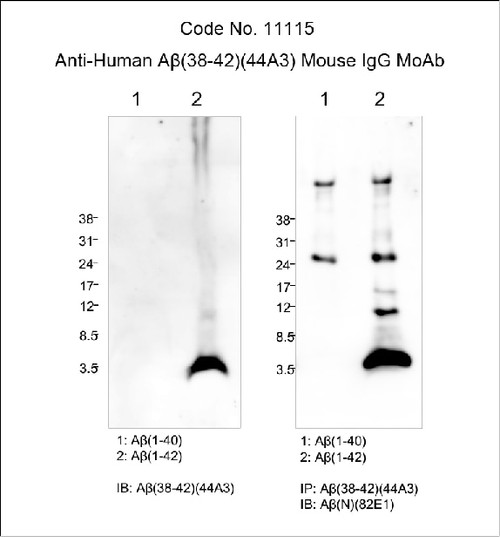
Amyloid Beta ( 38-42 ) ( 44A3 ) Aβ Anti-Human Mouse IgG MoAb
Alzheimer's disease (AD) is characterized by the presence of extracellular plaques and intracellular neurofibrillary tangles (NFTs) in the brain. The major protein component of these plaques is beta...
Add to Cart$596.00 -

Reticulocalbin-1 (TMU-6A1) Anti-Human Mouse IgG MoAb
Human Reticulocalbin-1 is a 44kDa protein and belongs to the EF (elongation factor) -hand calcium-binding protein family, and it is known as a luminal protein of endoplasmic reticulum (ER) with the...
Add to Cart$596.00 -

c-MPL/TPOR (AMM2) Anti-Mouse Rat IgG MoAb
Thrombopoietin promotes the growth and differentiation (proliferation) of megakaryocytes which produce platelets. TPOR (Thrombopoietin receptor), which is also called c-MPL (Myeloproliferative...
Add to Cart$596.00 -

ALK (mAb 16-39) Anti-Mouse Rat IgG MoAb
Anaplastic lymphoma kinase (ALK, anaplastic lymphoma kinase) is a receptor type tyrosine kinase, and is found to be expressed in the central and peripheral nervous system at late embryonic stage...
Add to Cart$596.00

Monoclonal Antibodies
Monoclonal antibodies (mAb or moAb) are derived from a single B-cell parent clone and therefore only recognize a single epitope per antigen.
These B-cells are immortalized by fusion with hybridoma cells, allowing for long-term generation of identical monoclonal antibodies.
Monoclonal antibodies specifically detect a particular epitope on the antigen and therefore are less likely than polyclonal antibodies to cross-react with other proteins.
IBL-America offers a wide range of monoclonal antibodies that can be used in the research and development of multiple laboratory testing applications.