
-
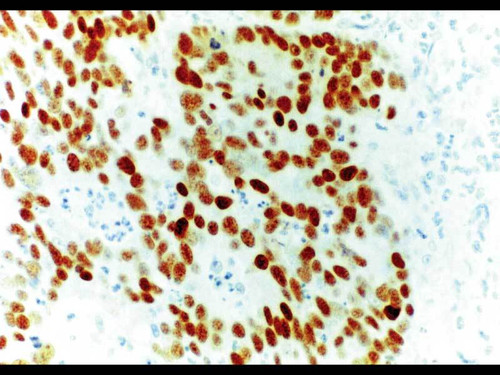
p53 (Bp53-12) Anti-Human Mouse IgG MoAb
At first, p53 was found not as a tumor suppressor gene product but as a cell protein of 53kDa that bind with the large T antigen of DNA type tumor virus SV40. Though at that time p53 was considered...
Add to Cart$596.00 -

Anti-Osteopontin N-Half (34E3) Mouse IgG MoAb
Osteopontin (OPN) is a secreted glycoprotein that was originally isolated from bone. Its molecular weights have been reported in the range of 66 kDa to 44 kDa depending on glycosylation and...
Add to Cart$596.00 -
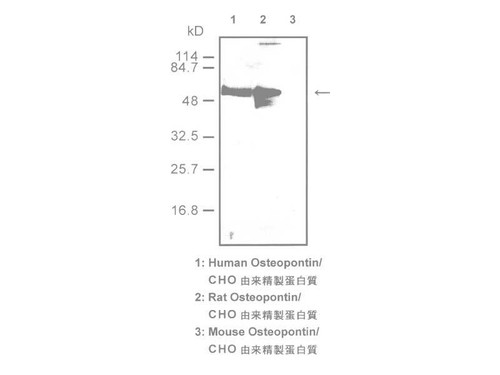
Osteopontin (1B20) Anti-Human Mouse IgG MoAb
Osteopontin (OPN) is a secreted glycoprotein that was originally isolated from bone. Its molecular weights have been reported in the range of 66 kDa to 44 kDa depending on glycosylation and...
Add to Cart$596.00 -

Osteopontin (10A16) Anti-Human Mouse IgG MoAb
Osteopontin (OPN) is a secreted glycoprotein that was originally isolated from bone. Its molecular weights have been reported in the range of 66 kDa to 44 kDa depending on glycosylation and...
Add to Cart$596.00 -
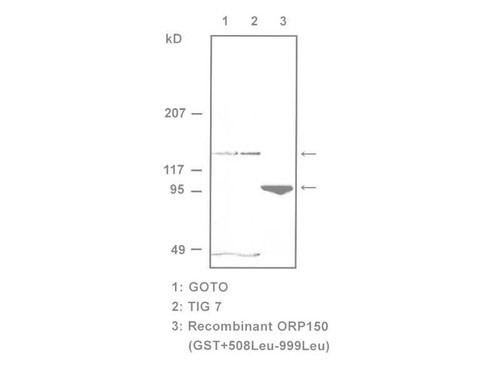
ORP150 (Oxygen Regulated Protein, p150) (2F07) Anti-Human Mouse IgG MoAb
Heat shock proteins (HSPs)/stress proteins are molecular chaperones that are induced by various environmental and physiological stimuli. The 150-kDa oxygen-regulated protein (ORP150), a new member of...
Add to Cart$596.00 -

OGG1 (7E2) Anti-Human Mouse IgG MoAb
Oxidative damage to DNA has been proposed to have a role in cancer and ageing. Oxygen-free radicals formed during normal aerobic cellular metabolism attack bases in DNA, and 7, 8-dihydro-8-oxoguanine...
Add to Cart$596.00 -

Anti-NSE (3-3-C) Mouse IgG MoAb
Enolase is an enzyme in glycolysis system and the protein consists of dimmer structure selected from three subunits α, β and γ. As αγ and γγ enolase exists such as in neuron cell and axis cylinder...
Add to Cart$596.00 -

Galectin-3 (38B2) Anti-Human Mouse IgG MoAb
Galectin is widely distributed in nematodes, insects, and porifers, as well as vertebrates, and it has also been found to be present in true fungi. Galectin does not just occur in the cytoplasm, it...
Add to Cart$596.00 -

Anti-Neurofilament, 160K, 210K, (N21-8-4) Mouse Ascites MoAb
Neurofilaments are the 10 nanometer (10nm) or intermediate filaments found specifically in neurons. The subunits of neurofilaments are related structurally to intermediate filaments of other tissues...
Add to Cart$596.00 -

Anti-mTOR (N5D11) Mouse IgG MoAb
Rapamycin is a lipophilic macrolide compound and induces a G1 phase growth arrest in S. cerevisiae and mammalian cells. The mammalian target of rapamycin (mTOR) has a molecular weight of 290 kDa and...
Add to Cart$596.00 -

MDMX (77A1) Anti-Human Mouse IgG MoAb
The p53 tumor suppressor protein is stabilized in response to cellular stress, resulting in activation of genes responsible for either cell cycle arrest or apoptosis. The cellular pathway for...
Add to Cart$596.00 -

MCP-1 Anti-Rat Mouse IgG MoAb
Human macrophage/monocyte chemotactic and activating factor (MCAF) also called human macrophage chemoattractant protein-1 (MCP-1) is an 8.6 kDa protein containing 76 amino acid residues. It plays an...
Add to Cart$596.00

Monoclonal Antibodies
Monoclonal antibodies (mAb or moAb) are derived from a single B-cell parent clone and therefore only recognize a single epitope per antigen.
These B-cells are immortalized by fusion with hybridoma cells, allowing for long-term generation of identical monoclonal antibodies.
Monoclonal antibodies specifically detect a particular epitope on the antigen and therefore are less likely than polyclonal antibodies to cross-react with other proteins.
IBL-America offers a wide range of monoclonal antibodies that can be used in the research and development of multiple laboratory testing applications.