
-

Anti-BACE1 (42) Rabbit IgG Affinity Purify 1
The current understanding of the role of amyloid in Alzheimer's disease (AD) has been established by a remarkable congruence of multiple disciplines: neuropathology, biochemistry, molecular biology,...
Add to Cart$143.00 -

Anti-Human BACE (C) Rabbit IgG Affinity Purify 1
The current understanding of the role of amyloid in Alzheimer's disease (AD) has been established by a remarkable congruence of multiple disciplines: neuropathology, biochemistry, molecular biology,...
Add to Cart$143.00 -
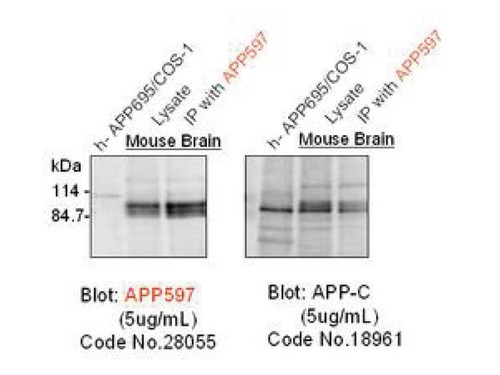
APP (597) Anti-Mouse/Rat Rabbit IgG Affinity Purify 1
Amyloid precursor protein (APP) is precursor protein of Amyloid β which is major constituent of senile plaque in Alzheimer's disease. It is known that there are three major isoforms, APP695, APP751...
Add to Cart$143.00 -
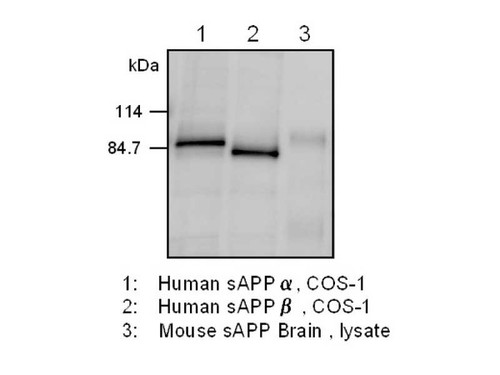
Anti-APP (18) Rabbit IgG Affinity Purify 1
Amyloid precursor protein (APP) is precursor protein of Amyloid β which is major constituent of senile plaque in Alzheimer's disease. It is known that there are three major isoforms, APP695, APP751...
Add to Cart$143.00 -

ApoE (A299) Anti-Human Rabbit IgG Affinity Purify 1
Apolipoprotein E (ApoE) is a structural component of very low-density lipoprotein (VLDL) synthesized by the liver and intestinally synthesized chylomicrons. It is also a constituent of a subclass of...
Add to Cart$143.00 -
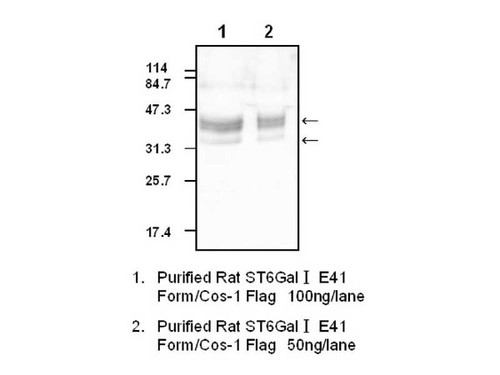
Anti-α2, 6-Sialyltransferase (M2) Rabbit IgG Affinity Purify 1
The histopathological picture of Alzheimer’s disease is characterized by senile plaques and neurofibrillary tangles, and because the senile plaques form first, they are considered the initial lesion...
Add to Cart$143.00 -

α2, 6-Sialyltransferase (E41) Anti-Rat Rabbit IgG Affinity Purify 1
The histopathological picture of Alzheimer’s disease is characterized by senile plaques and neurofibrillary tangles, and because the senile plaques form first, they are considered the initial lesion...
Add to Cart$143.00 -

Adiponectin Receptor 2 Anti-Human Rabbit IgG Affinity Purify 1
It has been reported that mast cells secrete various bioactive substances (adipokines), in addition to serving as a place for energy storage. Adiponectin has been shown to be one of the adiopkines...
Add to Cart$143.00 -

14-3-3 σ Protein (N) Anti-Human Rabbit IgG Affinity Purify 1
The 14-3-3 proteins are a family of conserved regulatory molecules expressed in all eukaryotic cells. A striking feature of the 14-3-3 proteins is their ability to bind a multitude of functionally...
Add to Cart$143.00 -

14-3-3 σ Protein (C) Anti-Human Rabbit IgG Affinity Purify 1
The 14-3-3 proteins are a family of conserved regulatory molecules expressed in all eukaryotic cells. A striking feature of the 14-3-3 proteins is their ability to bind a multitude of functionally...
Add to Cart$143.00 -

14-3-3 σ Protein (69) Anti-Human Rabbit IgG Affinity Purify 1
The 14-3-3 proteins are a family of conserved regulatory molecules expressed in all eukaryotic cells. A striking feature of the 14-3-3 proteins is their ability to bind a multitude of functionally...
Add to Cart$143.00 -

14-3-3 η Protein Anti-Human Rabbit IgG Affinity Purify 1
The 14-3-3 proteins are a family of conserved regulatory molecules expressed in all eukaryotic cells. A striking feature of the 14-3-3 proteins is their ability to bind a multitude of functionally...
Add to Cart$143.00

Polyclonal Antibodies
Polyclonal antibodies (pAbs) are a combination of antibodies, derived from the immune response of multiple B-cells, and each one recognizes a different epitope on the same antigen.
Polyclonals are produced by injecting an animal with an antigen. This elicits the immune response that produces antibodies against that antigen. The polyclonal immunoglobulins are then purified from the animal’s blood serum.
IBL-America offers a wide range of polyclonal antibodies that can be used in research using multiple laboratory testing methods.